
Rejection as far as the eye can see: why job boards don't work

Rejection is hard. Spending hours scrolling through hundreds of job posts on job boards just to submit my resume into an abyss I rarely heard back from prepared me quite well for the online dating world.
Now that I get to spend some of my time writing articles on topics I find interesting I wanted to look under the hood and see what the deal was with job boards. I took a snapshot of data science jobs (but this analysis applies to most jobs) posted on Glassdoor, LinkedIn, and Indeed and came up with the answers to some of my questions (my methodology for getting the data is detailed below):
- 10% of companies post 66% of the jobs across Glassdoor, LinkedIn, and Indeed.
- Recruiting agencies account for 14% of all the job posts on the three sites. Nothing screams “Apply here!” like when a job description won’t even tell you which company you’re applying to.
- If you’re going to use a job board I recommend Glassdoor. Glassdoor has a similar number of data science jobs as LinkedIn but the % of jobs that are posted by recruiting companies is much lower (8% vs 23%, respectively).
Power Posters Pursue Pareto Principle (or, 20% of companies post 76% of jobs)
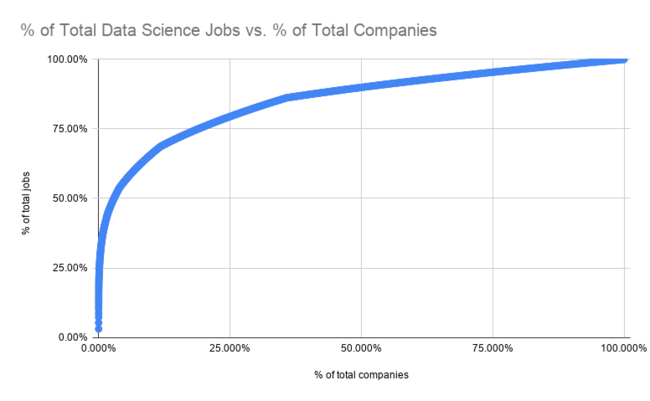
The alliterative title for this section took me WAY too long to come up with. Like I stated above, 10% of companies posted 66% of data science job openings and 20% of companies posted 76% of the jobs across Indeed, Glassdoor, and LinkedIn. This roughly follows the Pareto Principle. I’m always surprised how frequently the 80/20 rule bears out in real life.
Now it’s time to play a game. Which non-recruiting companies posted the most data science jobs on these job boards? (Cue Jeopardy music):
- Up first, the company behind the supercomputer that demolished Ken Jennings and Brad Rutter in Jeopardy! (I promise this is my last Jeopardy reference, I'm just really excited for the "Greatest of All Time" showdown). IBM accounted for 2.2% of the total job posts.
- In a close second we have Amazon at 2.0% of the total data science posts.
- Uber and Novartis are tied for third with 1.4% of the total job posts.
All of these companies paled in comparison to the total number of jobs posted by the recruiting agency Harnham. They accounted for a whopping 3.1% of all data science job posts on Indeed, Glassdoor, and LinkedIn.
As a side note, I wanted to mention how good Amazon is at search engine optimization. If you Google “Data Science Jobs” Amazon is the only company not in the hiring space to rank on the first page. They link to a page where they show they’re hiring for 250 data scientist positions! This keyword gets roughly 12,000 searches in the US each month so they likely get a sizable number of applicants with this approach.
Recruiting Agencies Account for 14% of All Job Posts
Not all sites are created equal in this regard. 23% of data science job posts on LinkedIn were from recruiting agencies, while for Glassdoor and Indeed 8% of all posts were from recruiting agencies. Keep in mind these are conservative estimates. I manually tagged companies as recruiting agencies so I likely overlooked some.
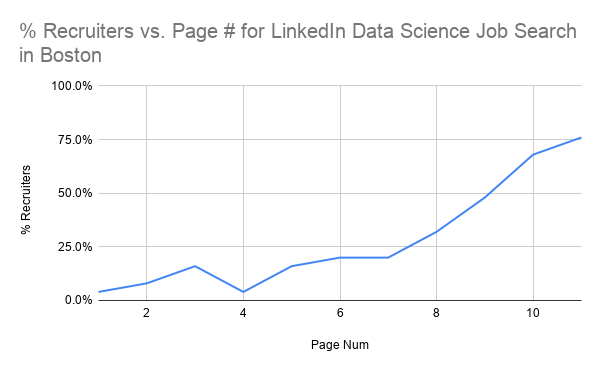
While 23% of the data science job posts on LinkedIn were from recruiting agencies, the agency posts are largely concentrated in the later pages of results. For example, here is the breakdown of the % of jobs from recruiting agencies by page number for Linkedin in Boston:
Data and Methodology
The data I’m presenting here is a snapshot in time from November 17, 2019. That is, I looked at all of the data science jobs on Glassdoor, LinkedIn, and Indeed on that day in the cities listed in the chart above. How did I get this data? The good old fashioned way, manually. I’ve made a lot of mistakes since I started BeamJobs, one of which was engineering too early. So rather than build a scraper for this one-off analysis I spent about 15 hours getting all of the companies hiring for data science roles.
To execute my searches I filtered the jobs to contain the exact string “data scientist”, were full-time, and were within 10 miles of the city I was searching for. For remote roles I chose the location as “remote” based in the US. I did some minor processing of company names to standardize them across sites (for example removed the “Inc” from company names).
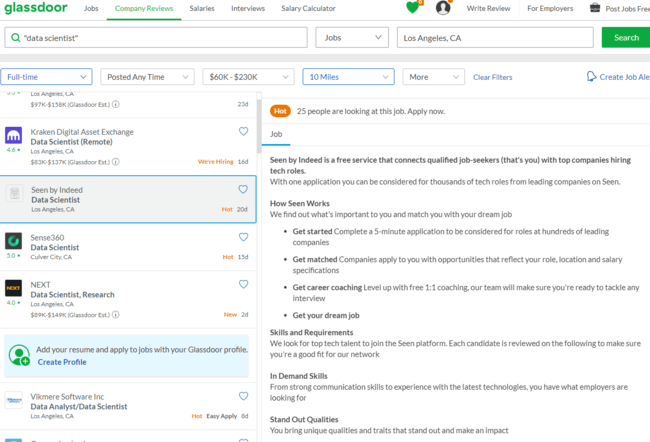
Once I had all of the companies hiring data scientists I looked up each company to see whether or not it was a recruiting agency. For the purposes of this analysis I counted any company that was not directly hiring as a recruiting agency. Interestingly enough, there is some crossover in terms of job boards advertising on other job boards:
I then looked at the non-recruiting companies on each site to see which companies no other site had. The logic here is that if you’re going to use two job boards you want to be sure you’re not seeing the same roles and companies on each job board. So by starting with the job board that has the highest coverage (in terms of total number of roles and total number of unique companies) you can save yourself time and effort.
Stephen Greet
Co-founder @ BeamJobs