
Quality resumes get 316% more interviews

Stop me if you've heard something like this before: "The 3 tricks hiring managers don't want you to know about that GUARANTEE an interview".
Most articles on the topic of resumes and job searching are riddled with anecdotes from self-proclaimed experts.
This makes sense. Looking for a job is an incredibly personal experience and it's easy for these "experts" to promise you a silver bullet.
The reality is more sobering: there are so many variables at play that it can seem nearly impossible to draw any overarching conclusions about the process. That's where data comes into play.
For any given person looking for a job consider all of the potential factors that determine whether they get an initial interview or not.
- How many years of experience do you have?
- What kind of job are you looking for?
- What’s the size of the company you’re applying for?
- How long is your resume?
- How much do they pay?
- Did you catch the recruiter who first reviews your resume before or after they have had their afternoon coffee?
I can’t tell you how important the answers to each of these questions is but from personal experience, you want to catch the recruiter AFTER they have had their afternoon coffee.
Since we launched our resume builder over 800,000 people have used our tool to build and improve their resumes.
By surveying our users we’ve learned that the quality of a resume has a direct and significant impact on the rate at which people get initial interviews. In fact, a candidate with a strong resume vs a weak resume is 3 times more likely to get an interview.
This has downstream effects on your career earnings. More interviews mean more job offers which means more leverage in negotiation which means a higher salary in your next job. A higher salary in your next job means a higher salary in your job after that and so on and so forth.
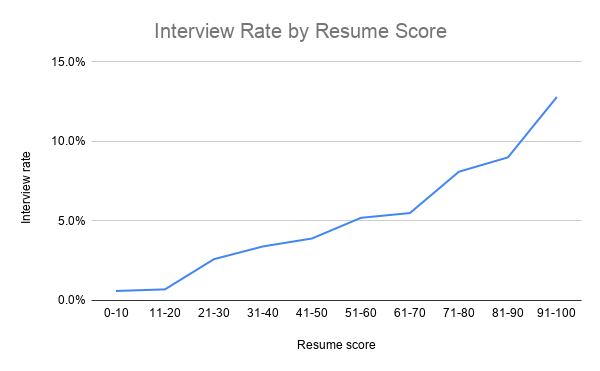
Controlling for factors such as years of experience, location, industry, and career type, a “quality” resume gets a first-round interview 9.9% of the time on average.
A poor resume on the other hand gets an initial interview only 3.1% of the time.
For those doing the math at home, this means a job applicant with a strong resume is 316% more likely to get an interview from any given job application.
That’s all well and good (and I hope interesting). But you're likely wondering, who are you and why do you get to decide what a “quality” resume is?
Every resume that is created on our platform gets a resume score ranging from 0-100. This score is based on factors that matter in determining whether a resume turns into an interview based on our conversations with hiring managers and through our data. Any score above 70 is considered “quality” based on the jump in the graph below (an admittedly arbitrary cutoff).
The specifics of what these factors are and how much they matter will be a topic of a different post. For now, suffice it to say that our data shows higher scores mean more interviews.
If you want to see your own resume score you can do so using our resume checker.
Once a job candidate gets a first-round interview with a recruiter, the quality of their resume doesn’t really matter. At this point, there is not a significant difference between the job offer rate of quality vs poor resumes.
This means that the purpose of your resume is to get you an initial interview. After that, your interview skills will carry you to glory (and a new job).
The data presented here is not all-encompassing and has some room for improvement. First and foremost in our analysis, we had no insight into the jobs users were applying for.
So if a new college graduate applied for VP level roles they were still included (shoot your shot!).
Remember, the goal of your resume is to get you in the door. Luckily we have the tools that can help you unlock that door.